Why my loricariid won’t touch zucchini until it’s been blanched exactly 90 seconds
Why my loricariid won’t touch zucchini until it’s been blanched exactly 90 seconds
I’ve been keeping fish for about six years now, and I still make mistakes that make me feel like a beginner. The kind where you stand in front of the tank, holding a piece of vegetable, and realize you’ve been doing it wrong the whole time. My latest obsession is a Loricariidae—specifically, a Panaque nigrolineatus that I picked up from a small shop in the industrial part of town, not the fancy pet store near the mall. The guy who sold him to me, older fella with a thick accent I couldn’t place, said, “He’ll eat anything, but you gotta treat the zucchini right.” I should’ve asked more questions.
Instead, I spent three weeks watching my fish ignore perfectly good zucchini. I’d slice it, drop it in, wait. Nothing. The pleco would drift over, give it a sniff, and swim away. I tried thicker slices, thinner slices, organic, non-organic, leaving the skin on, peeling it. Each failure cost me about 45 cents per zucchini, which doesn’t sound like much until you’ve thrown out eight of them in a row. That’s like four bucks I could’ve spent on something else—a better light, maybe, or a pack of frozen bloodworms.
The morning I finally figured it out was a Tuesday. Raining outside, which always makes the tank look greener. I had a meeting at 10, so I was rushing. I threw a slice of zucchini in a bowl of hot tap water—the kind you’d use for instant coffee, maybe 90 seconds’ worth—while I answered an email. Forgot about it. When I drained the water, the zucchini was warm but not mushy. I dropped it in the tank, and the pleco went at it like it was the first thing he’d eaten in months. Started chewing on the edge, rasping his little mouth against it. I stood there, coffee getting cold, watching him eat for a solid ten minutes. That’s when I realized the timing mattered more than I thought.
A Tuesday morning, coffee going cold
The first mistake was not blanching at all. I figured, “Fish eat plants in the wild, right? They’re not cooked.” And technically, that’s true. But the zucchini I’m buying is from a grocery store in February—it’s been refrigerated, shipped across a couple states, probably picked weeks ago. It’s not the same as a fresh, sun-warmed squash that’s still attached to the vine. The cell walls are tougher. The fibers are more stubborn. My pleco’s mouth can only rasp so hard. The raw zucchini might as well have been a rock.
I tried leaving it in the tank for three days once, hoping it’d soften on its own. It didn’t. It just sat there, slowly rotting, turning the water cloudy. I had to do a 30% water change, which cost me about an hour and a half of my Saturday afternoon. The filter smelled like old salad for a week. My wife walked past the tank and said, “What died in there?” Nothing died. Just my pride.
Then I tried boiling it for five minutes. That was worse. The zucchini turned into a mushy, translucent mess that fell apart when I tried to pick it up with tongs. It sank to the bottom and disintegrated into a cloud of green particles that the filter couldn’t catch. The pleco swam through it like it wasn’t there. I vacuumed the gravel the next day and found bits of zucchini skin that looked like wet tissue paper. That cost me a filter rinse and a bag of activated carbon I didn’t need to replace yet.
Ninety seconds on the phone timer
Here’s what I’ve settled on, after probably two dozen failed attempts: I boil a pot of water—doesn’t have to be distilled, just regular tap water from the kitchen—and drop the zucchini slice in for exactly 90 seconds. Not 60. Not 120. Ninety. I use my phone timer because I’ve overdone it too many times trying to guess. The difference between 90 seconds and 2 minutes is the difference between a firm, slightly softened vegetable that holds its shape and a limp, sad thing that falls apart when you look at it.
After the 90 seconds, I fish the slice out with a slotted spoon and drop it into a bowl of cold water—sometimes with an ice cube if I remember. That stops the cooking. Then I pat it dry with a paper towel. Not because it matters for the fish, but because I don’t want extra water dripping into the tank and messing with my parameters. I’ve got hard water, pH around 7.6, and I try to keep things stable.
The texture you’re aiming for is like a slightly undercooked carrot. It should give when you press it, but not collapse. The skin should still be intact, maybe a little looser than when it went in. If you can peel the skin off easily with your fingers, you’ve gone too long. The pleco needs that skin to grip onto while he eats the flesh underneath. It’s his anchor.
What happens if you get it wrong
Undercooked: the fish ignores it, you leave it in for 24 hours hoping, then you fish out a slightly wilted piece of vegetable that nobody touched. The water starts to smell faintly of plant matter. You wonder if your fish is sick. He’s not. He’s just spoiled.
Overcooked: the zucchini breaks apart in the water. Particles get into the substrate, into the filter intake, into places you can’t reach. Your ammonia spikes because there’s decomposing plant material that nobody’s eating. My test kit—the API Master Kit, the one with the drippy bottles that costs about 35 bucks—showed 0.25 ppm ammonia the day after I accidentally left a mushy slice in overnight. That’s not catastrophic, but it’s not nothing. I had to skip feeding for a day and add some Seachem Prime to bind it. The bottle cost me eight dollars, and I used maybe a capful. Not a huge loss, but it adds up.
The Saturday I spent elbow-deep in gravel
This was three weeks ago. I was prepping zucchini for the pleco and also cooking dinner—pasta with marinara—and I got distracted. The timer went off, but I thought, “I’ll grab it in a second.” That second turned into four minutes because I was draining pasta and my wife asked me something about the mail. When I finally remembered, the zucchini had been in the boiling water for over six minutes. It was basically mush. I fished it out anyway, thought maybe he’d still eat it, and dropped it in the tank.
He didn’t touch it. Of course he didn’t. But I left it in because I was tired and didn’t want to deal with it. That was Friday evening. Saturday morning, the water looked like weak tea. The zucchini had broken apart and settled between the rocks. My filter had slowed down because the intake sponge was clogged with green sludge. I spent that whole Saturday—from 9 a.m. to about 3 p.m.—doing a deep clean. I pulled out the driftwood, vacuumed every inch of gravel, rinsed the filter media in tank water, did a 50% water change. My back hurt. My hands smelled like fish tank for the rest of the day. And when I was done, the pleco was hiding behind the heater, looking at me like I was the one who’d messed up. Which I was.
The cost: about six hours of my weekend, half a bottle of Prime, a pack of filter floss I had to buy from the LFS for four dollars, and the satisfaction of a normally clean tank being compromised because I was lazy with a vegetable.
The shop guy’s useless advice
Most of the advice online is either too vague or too precise in the wrong way. Forum posts will say “blanch it for a bit” or “until it’s soft.” YouTube videos will show someone doing it in 30 seconds with no explanation. One guy in a comment section swore by microwaving the zucchini for 15 seconds. I tried that. The zucchini came out hot on the edges and cold in the middle. The pleco ignored it. Another person said to drop it in the tank raw and let the snails soften it up first. I don’t have snails. I have a bristlenose with opinions.
When I went back to the shop for algae wafers, I finally asked the guy: “How long exactly do you blanch it?” He shrugged and said, “Until it smells like zucchini.” That’s not helpful. Everyone’s nose is different. My wife thought the raw zucchini smelled like nothing. I thought it smelled like dirt. So I spent a month trying to calibrate my own sense of smell to some imaginary zucchini-ness threshold. That was stupid. I should’ve just timed it.
The thrift-store pot, the silicone tongs, the quarter-inch slices
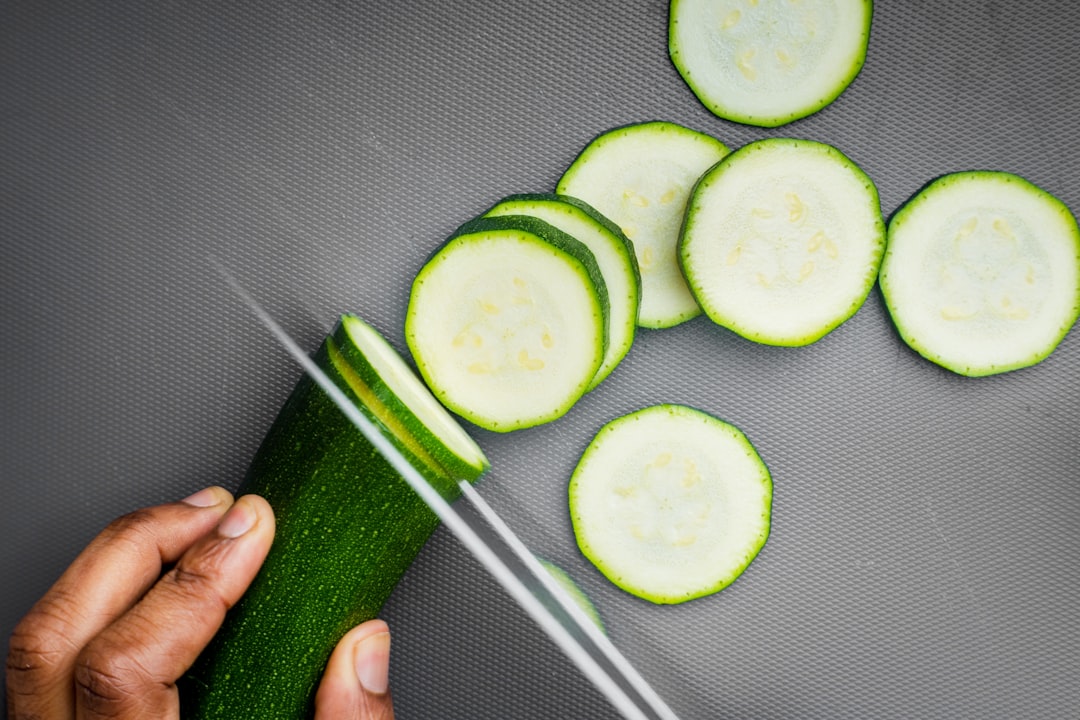
I keep a dedicated pot for fish food. It’s a small one, maybe two quarts, that I bought at a thrift store for two dollars. I don’t use it for human food anymore because I’m paranoid about cross-contamination, even though boiling water would probably kill anything. But it’s nice to have a system. I fill it with water, bring it to a rolling boil, and drop in one zucchini slice at a time. I use a serrated knife to cut discs about a quarter-inch thick. Thicker and they take longer to soften; thinner and they fall apart.
I set my phone timer for 90 seconds. I stand there and watch it. If I have to step away, I turn off the stove and take the pot off the burner. I’ve learned not to multitask during the 90 seconds. It’s barely a minute and a half. I can spare that much attention for a fish that I’ve spent probably two hundred dollars on between the fish itself, the tank upgrades, and the food experiments.
When the timer goes off, I pull the zucchini out with tongs—the silicone-tipped ones from the kitchen, not the metal ones that might scratch the glass—and drop it into a bowl of cold water. I let it sit for maybe a minute, until it’s room temperature. Then I pat it dry, check the texture with my thumb, and drop it in the tank. The pleco usually comes out within five minutes. Sometimes he waits until the lights go off, but I’ve watched him with a flashlight after dark, and he always goes for it.
The one time it didn’t matter
Last week, I bought a zucchini from a farmer’s market in late June. Local, probably picked that morning. I blanched it for 90 seconds as usual, but the skin was so thin and tender that it practically melted. The pleco ate it anyway. So maybe the 90-second rule is a guideline, not a law. But for the average grocery-store zucchini in January? It’s gospel.
Don’t assume your fish reads the same forums you do
Don’t overthink it, but don’t underthink it either. Get a timer. Use the same pot. Cut consistent slices. If you’re not sure, err on the side of undercooked—you can always leave it in the tank an extra day, and the water movement will soften it eventually. Overcooked is a mess you can’t undo.
Also, don’t assume your fish likes zucchini just because the internet says all loricariids do. Mine ignored it for three weeks. Turns out he just wanted it blanched. My friend’s bristlenose pleco eats raw cucumber with no prep at all. Every fish is a little different, and they don’t read the same forums we do.
I spent maybe 15 dollars on wasted zucchini before I got it right. That’s not a fortune, but it’s 15 dollars I could’ve spent on frozen brine shrimp or a new plant. The real cost was the time—the weekends I spent cleaning up failed experiments, the evenings I stood staring at the tank wondering what I was doing wrong. If I could go back and tell myself one thing, it would be: boil water, count to 90, and trust that it’s enough. It usually is.
📷 Photos: Louis Hansel (Unsplash), David Trinks (Unsplash)