The cracked heater and the fifty-euro lesson
The cracked heater and the fifty-euro lesson
The first attempt ended in a tank full of green water and a heater that cracked overnight. That was the cost of learning, roughly — a fifty-euro heater, three weeks of algae scrubbing, and the slow realization that warm water and a partial water change were not, in fact, the same thing as a flood cycle.
Apistogramma agassizii comes from the slow-moving blackwater tributaries of the Amazon basin, where the dry season concentrates fish into shrinking pools and the wet season spreads them back out across flooded forest floor. The fish that end up in aquariums still carry that memory. They don’t spawn because the keeper wants them to. They spawn because something in the water tells them the rains have arrived.
The single-event trap
The mistake most people make is treating the trigger as a single event — a big water change, a temperature drop, a feeding of live foods. None of those work alone because a flood is not a single thing. It is a sequence of changes that happen over days, and the fish respond to the sequence, not to any one variable.
In the wild, the dry season means stable, slightly acidic water with very low conductivity — sometimes below 20 microsiemens. The fish hold in deep pools, feeding sparingly, metabolisms slowed. Then the rains come. The water level rises. New water flushes through, carrying dissolved minerals from the forest floor, dropping the temperature by a few degrees, and diluting the existing chemistry. Conductivity rises briefly as the first flush picks up leaf litter and sediment, then drops again as the floodplain fills.
The trigger is not “cold water.” The trigger is “fresh water arriving after a period of stable stagnation.”
Twenty liters a day, nothing to show
A twenty-liter water change every day for a week seemed aggressive enough. The water was RO, remineralized to about 50 microsiemens with a trace of blackwater extract. Temperature dropped by two degrees with each change. The fish looked interested — the male displayed more, the female showed a hint of yellow in the ventral fins — but nothing happened.
The problem became obvious only after reading through a forum thread from 2019 that someone had resurrected with a new comment. The member, a breeder in Germany who had been working with apistogrammas for over a decade, had posted a detailed timeline of how he did it. The key detail: he didn’t just change water. He let the water level drop first.
That was the missing piece. The dry season is not just “less water.” It is a visible, gradual drop in water level that concentrates the fish, reduces available hiding spots, and signals that conditions are about to become hostile. The fish enter a holding pattern. Then the water returns, and the holding pattern breaks.
The half-coconut shell
The tank was a standard sixty-centimeter, about fifty-four liters. Bare-bottom except for a thin layer of almond leaves and a single piece of bogwood. A sponge filter, a small heater set to 26°C, and a lid with a gap for evaporation. No other fish — just a pair of A. agassizii, a male and a female, both wild-caught and about eight months in the tank.
The approach changed completely. Instead of daily water changes, the water level was allowed to drop naturally over ten days. Evaporation did most of the work. By day eight, the water level had fallen by about a third. Conductivity had crept up to around 80 microsiemens as the remaining water concentrated. The female had turned a deep, rich yellow. The male was patrolling the front glass, fins flared, chasing his own reflection.
On day ten, a fifty-percent water change was done with RO water at 22°C, remineralized to about 30 microsiemens. The water was added slowly, over the course of an hour, through a drip line. The temperature in the tank dropped to 24°C by the end. The male went into an immediate, frantic display, dancing in front of the cave — a half-coconut shell turned on its side — while the female inspected it repeatedly.
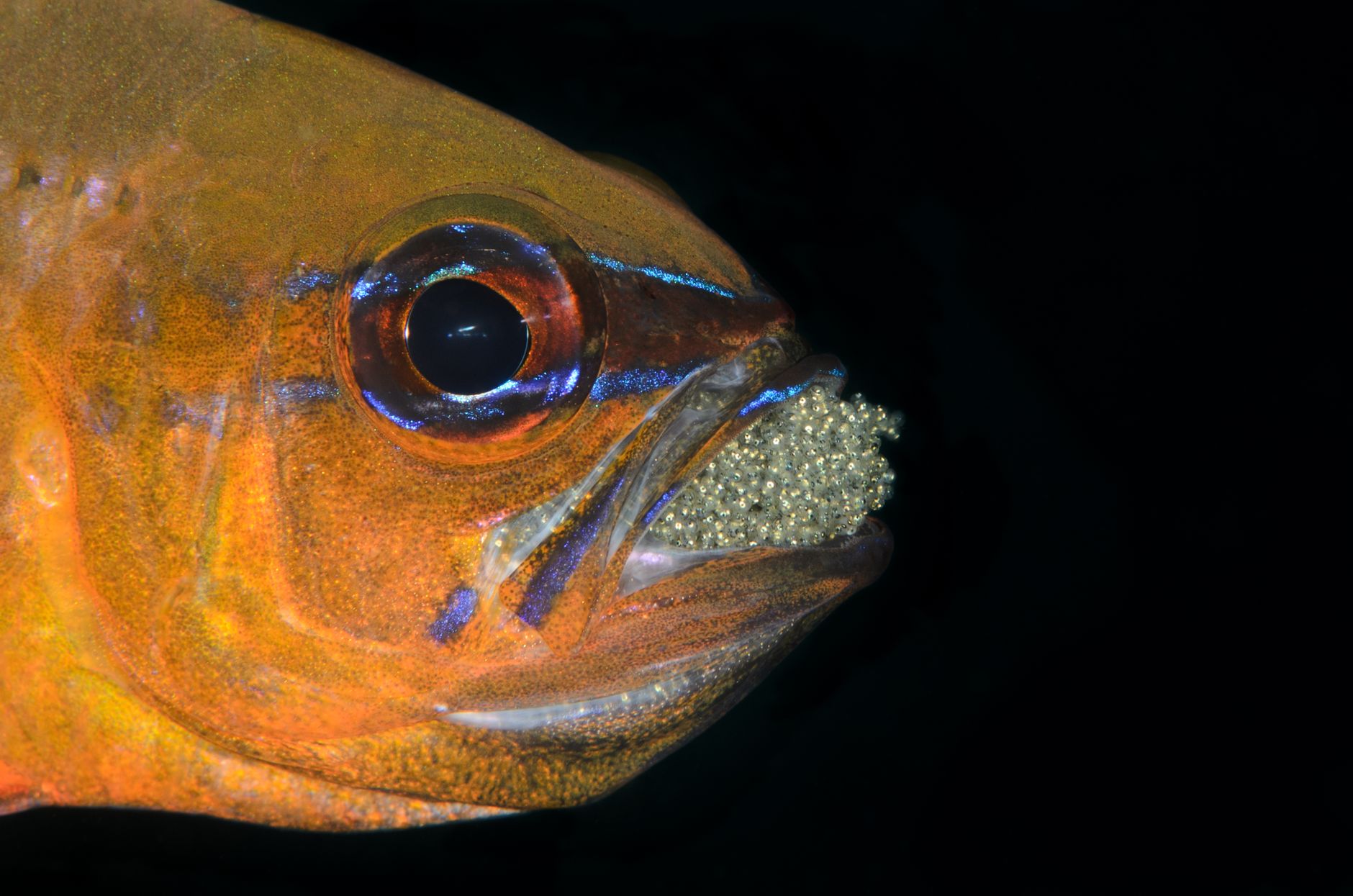
Within forty-eight hours, she had laid a clutch of about sixty eggs on the underside of the coconut shell. The male guarded the approach. The female tended the eggs, fanning them constantly.
The biofilm no one talks about
Water chemistry gets most of the attention in online discussions, but the practical execution mattered just as much. A few specifics:
The drip line was a simple airline tube with a valve, running from a bucket elevated above the tank. The flow rate was adjusted to about one drop per second. Faster than that, and the temperature swing stressed the female — she abandoned the eggs once during the second attempt, which used a faster addition rate. Slower, and the chemical change was too gradual to trigger anything.
The almond leaves mattered. Not for the tannins — those are mostly cosmetic in terms of trigger effect — but for the biofilm that grew on them. The fry needed infusoria within hours of becoming free-swimming, and the biofilm on the decomposing leaves was the only thing available in sufficient density. Powdered fry food was useless until day four or five.
The male was removed after the eggs hatched, around day three. Not because he would eat them — some males don’t — but because he became aggressive toward the female once the wrigglers emerged. She was smaller and could not defend both the fry and herself. Once he was out, she settled immediately and began moving the fry to a pit she had dug in the leaf litter.
Twelve days instead of seven
The first spawn produced about forty fry that survived to free-swimming. The second spawn, done with the same pair two months later, produced nearly ninety. The difference was timing.
The dry-season period had been too short the first time — only seven days of lowered water. The fish had responded, but the response was weak. Extending the drawdown to twelve days, with no water changes at all during that period, produced a much stronger reaction. Conductivity climbed to 110 microsiemens by the end. The female had lost some condition by then — she looked thin, and her color had faded — but within three days of the water return she was plump again and spawning.
The trade-off is real. A longer dry period stresses the fish. The female in particular loses weight because she stops feeding as consistently. But the stress is physiological, not pathological — it mimics exactly what happens in the wild, where the fish are adapted to withstand weeks of concentrated conditions before the floods arrive. The trick is not to avoid stress but to control its duration and intensity.
The sequence that worked
For anyone trying this with their own pair, the sequence that consistently worked across three spawns looked like this:
- Stop water changes. Let evaporation lower the water level by 30-40% over 10-12 days. Top up only if the tank drops below 50% of its original volume, and use RO water at tank temperature.
- Monitor the female. When she turns a deep yellow and begins cleaning a cave or surface, the drawdown has been long enough.
- Prepare the replacement water in advance. RO water at 22°C, remineralized to 20-30 microsiemens. Enough for a 50% change.
- Add the new water slowly through a drip line over 60-90 minutes. The temperature in the tank should drop by 2-3°C.
- Leave the tank undisturbed for 48 hours. No feeding, no lights, no maintenance. The female will likely spawn within that window.
- After spawning, resume normal feeding with live or frozen foods. Do not change water again until the eggs hatch.
The third spawn produced a clutch of over a hundred eggs. The female had become noticeably better at the process — she chose a better cave position, one with a clear escape route, and she defended the fry more effectively against the male before he was removed. Experience matters, even for the fish.
The next change would be starting the drawdown earlier in the week, so the water change falls on a Saturday rather than a Tuesday. Watching a spawn happen at midnight on a work night is not ideal, and the fish do not care about the keeper’s schedule.

📷 Photos: Ben Phillips (Pexels), Aradra P (Pexels)